
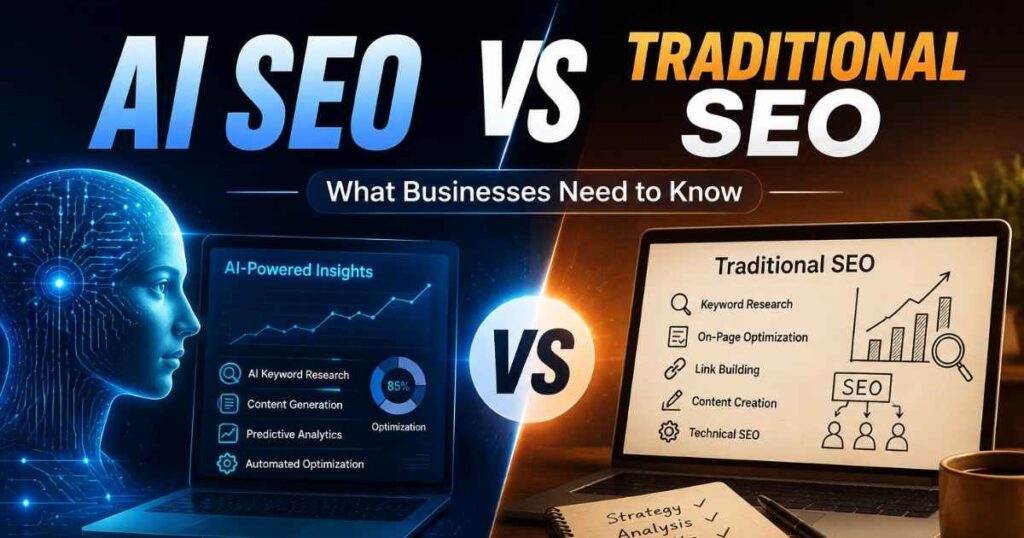
In 2026, search engines are changing faster than ever. AI-powered tools now generate answers directly in search results, while traditional ranking factors still matter. For small and medium business owners trying to improve Google rankings and generate leads online, the question isn’t whether to adopt AI—it’s how to balance AI SEO vs Traditional SEO for maximum results.
This article breaks down the key differences, pros and cons, and a practical hybrid strategy that works for businesses with limited budgets and teams.
What Is Traditional SEO?
Traditional SEO is the practice of optimizing your website using manual, human-driven techniques to rank higher in search engine results pages. It’s been the foundation of digital marketing for over two decades.
Core Components of Traditional SEO
- Keyword Research: Identifying high-volume, relevant keywords using tools like Google Keyword Planner or Ahrefs
- On-Page Optimization: Optimizing title tags, meta descriptions, headers, and content for target keywords
- Technical SEO: Improving site speed, mobile-friendliness, crawlability, and site structure
- Link Building: Earning backlinks from authoritative websites to boost domain authority
- Content Marketing: Creating valuable, original content that answers user queries and builds trust
Traditional SEO relies heavily on human expertise, experience, and consistent manual effort.
What Is AI SEO (AI-Powered SEO)?
AI-powered SEO uses artificial intelligence and machine learning to automate, enhance, or accelerate SEO tasks. It goes beyond keyword matching to understand search intent, generate content, predict trends, and optimize for AI-generated search responses.
Key Features of AI SEO
- Automated Keyword Research: AI tools analyze search patterns and suggest keywords with predictive insights
- Content Generation and Optimization: AI writes or enhances content based on top-performing competitors
- Competitor Analysis: AI scans competitor strategies and identifies gaps
- Performance Tracking: Real-time monitoring of rankings, traffic, and user behavior
- Optimization for AI Search: Structuring content for AI assistants like Google’s Search Generative Experience
AI SEO doesn’t just help you rank for keywords—it helps you become the trusted source when AI answers a question.
AI SEO vs Traditional SEO: Key Differences
| Aspect | Traditional SEO | AI-Powered SEO |
| Approach | Manual, human-driven | Automated, data-driven |
| Keyword Focus | Exact-match keywords | Search intent and topic clusters |
| Content Creation | Human-written, time-intensive | AI-assisted, faster production |
| Speed | Slower results (3–6 months) | Faster insights and iterations |
| Optimization Goal | Rank for keywords | Rank plus appear in AI-generated answers |
| Cost | Lower tool costs, higher labor | Higher tool costs, less labor |
| Originality | High (human creativity) | Risk of generic content without review |
The debate between AI SEO vs Traditional SEO isn’t about choosing one—it’s about understanding where each shines.
Is AI SEO Better Than Traditional SEO?
The short answer: Neither is outright better. Each has strengths, and the best results come from combining both.
When AI SEO Excels
- Speed: AI analyzes thousands of data points in seconds, identifying trends humans might miss
- Scale: AI can optimize hundreds of pages or generate content drafts rapidly
- Predictive Insights: AI forecasts which topics will gain traction before they peak
- AI Search Optimization: Essential for appearing in Google’s AI-generated summaries
When Traditional SEO Still Wins
- Brand Voice: Only humans can authentically capture your company’s unique tone
- Creativity: AI struggles with original storytelling and emotional connection
- E-E-A-T: Google prioritizes Experience, Expertise, Authoritativeness, and Trust—built through human expertise
- Quality Control: AI can hallucinate facts or produce culturally off-tone content without human review
For small businesses, is AI SEO better than traditional SEO? depends on your goals. AI accelerates execution, but human oversight ensures quality and credibility.
Why Small and Medium Businesses Need a Hybrid Strategy
Most small and medium businesses can’t afford to go all-in on expensive AI tools or dedicated SEO teams. A hybrid approach delivers the best ROI.
The Hybrid SEO Strategy
- Use AI for Research and Efficiency
- Automate keyword research and competitor analysis
- Generate content outlines and first drafts
- Identify content gaps and topic clusters
- Apply Human Expertise for Quality
- Rewrite AI content to match your brand voice
- Add real-world case studies, expert quotes, and original data
- Fact-check everything and ensure E-E-A-T signals
- Optimize for Both Humans and AI
- Write for humans first, format for AI (clear headings, FAQ sections)
- Use schema markup (Article, FAQ, HowTo, Organization)
- Create topic clusters with supporting citations
- Focus on Authority Building
- Publish consistently to build reliability
- Collaborate with industry experts
- Earn mentions and backlinks from high-authority sites
Practical AI SEO Best Practices for 2026
If you want to stay competitive, integrate these AI SEO best practices into your strategy:
Content Requirements
- Expert depth: Avoid generic advice; provide actionable examples
- Conversational tone: Match how people actually ask questions
- Unique insights: Include original viewpoints and data
- Frequent updates: Keep content fresh and accurate
Technical Requirements
- Mobile-optimized: Essential for AI and traditional rankings
- Rapid load times: Speed affects user experience and rankings
- Multimedia support: Voice, video, and images are now critical
Authority Signals
- E-E-A-T: Showcase real author bios, credentials, and experience
- Structured Data: Use schema markup for rich results
- Brand Mentions: Branded web mentions are the strongest correlation factor for AI search visibility
Engagement Metrics
- Dwell time: Keep visitors engaged with valuable content
- Bounce rate: Reduce exits by answering queries quickly
- Real user signals: Authentic engagement beats artificial metrics
Five AI Hacks That Improved Google Rankings
One agency shared five AI-powered tactics that boosted their rankings significantly:
- Create Templates for repeatable content types (product pages, blog posts)
- Add FAQs to product pages to match conversational queries
- Build a Reddit Strategy to earn authentic mentions and backlinks
- Competitor Research using AI to identify content gaps
- Build a Brand Bible to ensure consistent messaging across all content
These tactics work because they combine AI efficiency with human strategy.
Common Pitfalls to Avoid
Even with AI, mistakes happen. Watch out for these traps:
- Auto-publishing AI content without review (AI can be factually wrong)
- Keyword stuffing unnaturally (hurts readability and rankings)
- Ignoring brand voice (AI may sound confident but lack authenticity)
- Over-reliance on algorithms (search engine updates can break AI-dependent strategies)
- Skipping E-E-A-T (Google still prioritizes human expertise)
Remember: AI can offer speed and precision, but it can’t offer originality, brand voice, and intuition.
The Bottom Line: AI SEO vs Traditional SEO
The future of search optimization isn’t AI or traditional—it’s AI and traditional.
| Why Hybrid Wins | Explanation |
| Efficiency and Quality | AI speeds up research and drafts; humans ensure accuracy and voice |
| Rankings and AI Citations | Traditional SEO ranks for keywords; AI SEO appears in generative answers |
| Scalability and Trust | AI scales content production; humans build E-E-A-T and authority |
| Cost-Effective | Use AI for routine tasks, humans for high-value strategic work |
Businesses that embrace both approaches will dominate search rankings in the coming years.
Action Plan for Small and Medium Businesses
Ready to start? Here’s your 30-day roadmap:
- Audit Your Current SEO
Check if you’re clearly defining your brand, services, and location with schema markup - Rewrite Your Homepage
Make it conversational, question-friendly, and rich with entities - Pick a Core Topic Cluster
Publish 4–6 long-form pieces around one core topic in the next 90 days - Layer in FAQs
Anticipate what AI assistants would be asked and answer on your site - Track Shifts
Monitor not just rankings, but AI summaries and citations - Allow AI Crawlers
Update XML sitemaps and robots.txt to let AI crawlers access your content
Final Thoughts
AI SEO vs Traditional SEO isn’t a zero-sum game. For small and medium business owners, the winning strategy is clear: leverage AI for speed and scale, but never replace human expertise, creativity, and authenticity.
Start by auditing your current SEO, integrating AI tools for research and content drafts, and rigorously reviewing everything for quality and brand voice. Within 90 days, you’ll see improved rankings, stronger AI visibility, and more qualified leads.
Ready to optimize? Begin your hybrid SEO strategy today—your competitors already are.