
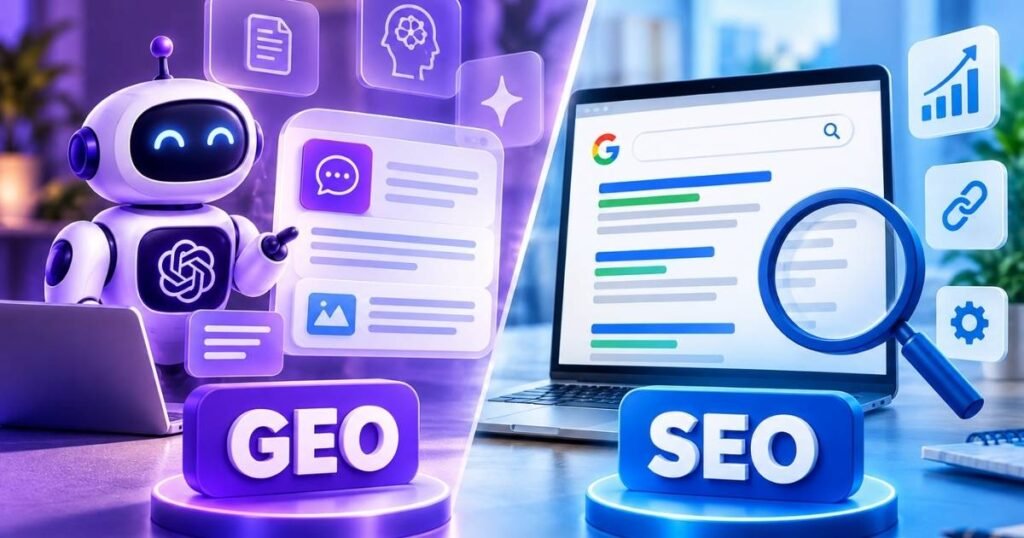
Search is changing quickly. For years, businesses mainly focused on getting their websites to appear in Google search results. That work is still important, but people now use AI tools and answer engines to find information, compare businesses, research products, and ask questions.
This change has created more interest in GEO vs SEO.
SEO, or Search Engine Optimization, focuses on improving a website’s visibility in traditional search engines. GEO, often called Generative Engine Optimization, focuses on improving the chances that a business, website, product, or piece of information is understood and mentioned by AI-powered search and answer systems.
Although both approaches have similar goals, they work with different types of technology and signals. Understanding the difference can help businesses create a stronger digital strategy.
What Is SEO?
GEO vs SEO stands for Search Engine Optimization.
The main goal of SEO is to help webpages become more visible in search engine results for relevant searches.
Search engines use automated systems to discover, crawl, understand, and organize webpages. Google explains that its systems use automated ranking systems to return relevant and useful results for searches.
SEO can involve many areas, including:
- Keyword research
- Website structure
- Technical SEO
- Page speed
- Mobile usability
- Content quality
- Internal links
- Backlinks
- Search intent
- Local SEO
- Structured data
- Image optimization
- Metadata
The goal is to make a website easier for both search engines and users to understand.
What Is GEO?
GEO vs SEO stands for Generative Engine Optimization.
GEO vs SEO focuses on visibility in AI-generated answers and answer-focused search experiences.
Instead of simply looking for a list of links, a user may ask an AI system a complete question.
For example:
“What are the best ways for a small business to improve its online visibility?”
An AI system may provide a direct answer and may mention businesses, websites, services, products, or sources that support the answer.
This changes the way businesses think about online visibility.
With traditional SEO, the goal may be to earn a strong position in a search results page.
With GEO vs SEO, the goal is to make information clear, useful, trustworthy, and easy for AI systems to understand and potentially use when generating an answer.
How Do Search Algorithms Work?
Search algorithms are systems that help determine which information should be shown for a user’s search.
Traditional search engines generally work through several major stages.
Crawling
Search engines discover webpages through links, sitemaps, and other methods.
Automated programs, often called crawlers, visit webpages and collect information about them.
Indexing
After a page is discovered, search engines analyze its content and other information.
The page may then be stored in a search index.
Being indexed does not automatically mean a page will rank highly.
Ranking
When someone performs a search, ranking systems evaluate available information and determine which results are most useful for that query.
Many signals can affect how pages are ranked.
This is where traditional SEO becomes important.
How Does AI Search Work Differently?
AI-powered search systems can use large language models and other technologies to understand questions and create natural-language responses.
Instead of simply matching a query with pages containing similar keywords, an AI system can analyze the meaning of the question and generate an answer based on information available to it.
Modern AI search experiences can combine language understanding, retrieval systems, search indexes, and other data sources.
The exact technology varies between platforms, and companies do not publicly disclose every part of their systems.
This means there is no single GEO algorithm that businesses can optimize for.
That is an important difference between GEO vs SEO.
SEO Has Known Search Ranking Signals
GEO vs SEO has a large body of public guidance and testing behind it.
Search engines provide documentation covering areas such as:
- Crawling
- Indexing
- Structured data
- Page experience
- Mobile SEO
- Technical SEO
- Spam policies
- Search appearance
Google also explains that its ranking systems use many signals and that no single factor guarantees a particular position in search results.
This gives SEO professionals a framework for improving websites.
However, rankings can still change because search systems are constantly updated.
GEO Does Not Have One Universal Algorithm
One of the biggest differences is that GEO does not have one universal ranking algorithm.
AI platforms can use different models, search systems, retrieval methods, data sources, and rules.
For example, an AI search product may use:
- A language model
- Search results
- Retrieved webpages
- Structured information
- Knowledge sources
- User context
- Fresh information
- Entity relationships
Another AI system may use a different process.
Because of this, GEO vs SEO should not be treated as a simple replacement for SEO.
Instead, businesses should build strong digital foundations that help their information remain clear and useful across different search environments.
Why Does Content Structure Matter for GEO?
AI systems need to understand information.
Poorly organized content can make this harder.
For example, imagine a service page that contains one large block of text explaining several services.
It may be difficult for a user to scan.
It may also be harder to clearly identify individual services, benefits, processes, locations, and answers.
A better structure could include:
- Clear H1
- Descriptive H2 headings
- Short paragraphs
- Lists
- Direct answers
- FAQs
- Specific service information
- Supporting examples
Good structure helps people read the page and gives machines clearer information to process.
Why Are Entities Important?
Search is becoming more focused on entities and relationships.
An entity can be a person, company, product, service, organization, location, or other identifiable thing.
For example, a website may clearly identify:
Company: EchoWings Media
Service: Website Development
Location: Holland, Michigan
Additional Services: SEO, GEO, Branding, E-Commerce Development
When these relationships are clear across a website and other trusted sources, it can help search systems better understand what a business is and what it offers.
This is useful for both GEO vs SEO.
How Do Backlinks Fit Into GEO?
Backlinks have traditionally been an important part of GEO vs SEO.
A backlink is a link from another website to your website.
Search engines can use links as part of understanding the relationship between webpages and websites.
For GEO vs SEO, GEO links can also matter indirectly because AI search systems may retrieve information from websites and other sources when producing answers.
However, businesses should not focus on getting random links.
Useful mentions from relevant and trusted websites are generally more meaningful than large numbers of low-quality links.
Does Keyword Research Still Matter for GEO?
Yes, but the approach can be broader.
Traditional SEO often starts with keywords.
For example:
- website development Holland MI
- SEO services Holland MI
- e-commerce website development
- local SEO services
GEO encourages businesses to think about questions and topics as well.
For example:
- How much does website development cost?
- What does an SEO company do?
- How can a local business improve Google visibility?
- What should an e-commerce website include?
- How can AI search help small businesses?
This does not mean abandoning keywords.
Instead, businesses can build content around both search terms and the questions customers actually ask.
How Does Search Intent Work in SEO and GEO?
Search intent is the reason behind a search.
Someone searching for:
“what is SEO”
is probably looking for educational information.
Someone searching for:
“SEO company Holland MI”
may be looking for a service provider.
Someone searching for:
“website development pricing”
may be researching costs before making a decision.
Understanding intent helps businesses create the right type of content.
This is important for both SEO and GEO because useful answers need to match what the user is actually trying to accomplish.
Why Does First-Hand Experience Matter?
AI-generated content has made the internet more crowded.
Businesses can now produce large amounts of generic content very quickly.
That makes original information more valuable.
Businesses can strengthen content by including:
- Real project examples
- Original research
- Case studies
- Customer questions
- Expert explanations
- First-hand experience
- Specific processes
- Local knowledge
- Original data
Instead of simply writing another article that repeats information found elsewhere, businesses can provide something useful that adds to the topic.
Google’s guidance also emphasizes creating helpful, reliable, people-first content rather than content created mainly to manipulate search rankings.
How Do Technical SEO and GEO Work Together?
Technical SEO remains important.
A website should be:
- Crawlable
- Indexable
- Mobile-friendly
- Secure
- Fast
- Well structured
- Easy to navigate
Technical problems can make it harder for search systems to access or understand website content.
GEO does not remove the need for these basics.
In fact, a strong technical foundation gives your content a better chance of being discovered and processed.
Does Schema Markup Help GEO?
Structured data helps websites provide machine-readable information about their pages.
Schema markup can describe things such as:
- Businesses
- Products
- Services
- Articles
- Events
- Reviews
- Organizations
- Locations
Google explains that structured data can help it understand the content of a page and can make pages eligible for certain search features. Structured data should be accurate and match the visible information on the page.
It is not a shortcut to rankings or AI mentions.
What Is the Biggest Difference Between GEO and SEO?
The simplest way to understand the difference is this:
SEO focuses heavily on visibility in search results.
GEO focuses on visibility and understanding within AI-generated answers and generative search experiences.
They overlap because both depend on useful information, strong website structure, clear content, technical accessibility, and trust.
The difference is mainly in the search environment and how information may be presented to the user.
Why Should Businesses Use Both SEO and GEO?
Search behavior is not limited to one platform.
A customer might:
- See a social media post.
- Search the company on Google.
- Read the website.
- Ask an AI tool for alternatives.
- Compare several businesses.
- Return to Google.
- Visit a service page.
- Contact the company.
A digital strategy should therefore not depend on only one source of traffic.
SEO can help businesses build traditional search visibility.
GEO can help businesses think about how their information is understood and surfaced in AI-powered search experiences.
Together, they provide a broader approach to modern search visibility.
How Can Businesses Prepare for AI Search?
Businesses can start with simple steps.
Create Clear Service Pages
Explain each service separately.
Do not put every service into one general page.
Answer Real Customer Questions
Create helpful content around questions customers actually ask.
Use Clear Website Structure
Make navigation, headings, links, and page relationships easy to understand.
Build Trust
Show reviews, case studies, experience, contact information, business details, and other useful trust signals.
Keep Information Updated
Update outdated prices, services, team information, locations, and other important details.
Strengthen Your Brand Across the Web
Keep business information consistent across your website, business profiles, directories, social platforms, and relevant third-party sources.
Continue Traditional SEO
Do not stop keyword research, technical SEO, content optimization, internal linking, local SEO, and other proven SEO practices.
Is GEO Replacing SEO?
No.
GEO should not be viewed as a complete replacement for SEO.
Traditional search engines remain an important way people discover information, businesses, products, and services.
At the same time, AI-powered search is creating new ways for people to ask questions and receive information.
Businesses should therefore think beyond one search channel.
The stronger approach is to build a website with useful content, good technical foundations, clear business information, strong brand signals, and a customer-first structure.
Frequently Asked Questions
Q. What is the main difference between GEO and SEO?
A. SEO focuses on improving visibility in traditional search engines, while GEO focuses on helping information become understandable and potentially visible within AI-generated search and answer experiences.
Q. Does GEO replace traditional SEO?
A. No. SEO remains important for traditional search visibility. GEO adds another layer of thinking for businesses that want to prepare for AI-powered search experiences.
Q. Do keywords matter for GEO?
A. Yes, but businesses should also think about topics, questions, entities, context, and the intent behind searches instead of focusing only on exact keyword phrases.
Q. Can schema markup guarantee GEO visibility?
A. No. Structured data can help search systems understand information, but it does not guarantee rankings, AI citations, or mentions.
Final Thoughts
The difference between GEO vs SEO is becoming important as search continues to change. SEO remains focused on helping websites become visible and useful within traditional search, while GEO considers how information can be understood and surfaced by AI-powered search and answer systems. Businesses do not need to choose one over the other. A strong digital strategy can use technical SEO, helpful content, structured information, clear entities, strong brand signals, and useful customer-focused pages to prepare for both environments.
EchoWings Media helps businesses build stronger digital foundations through website development, SEO & GEO, e-commerce development, branding, and website maintenance. Visit echowingsmedia.com and use the Contact option to discuss how your business can improve its search visibility and prepare for the changing world of AI-powered search.