
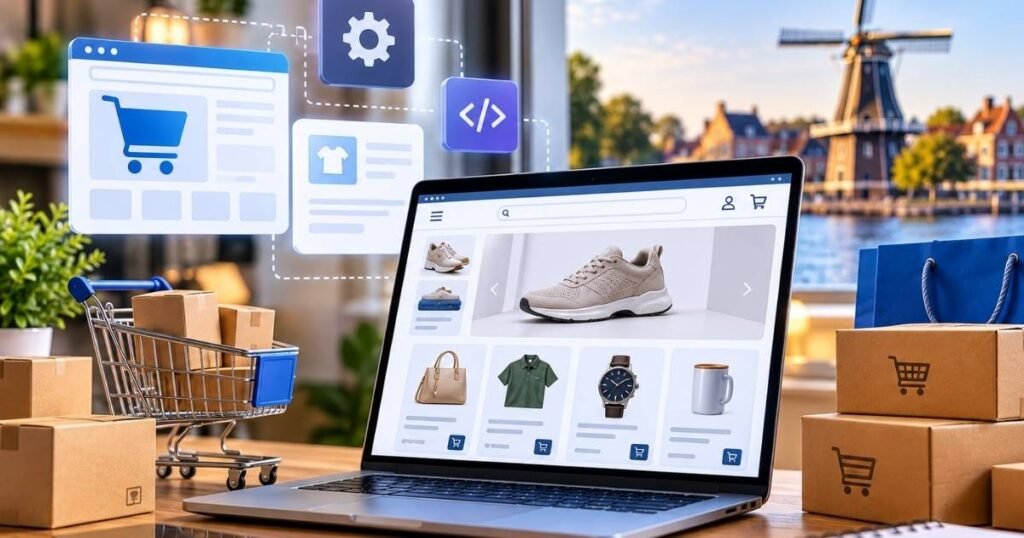
Online shopping has changed how customers discover products and make buying decisions. Even local businesses can benefit from having an online store that allows customers to browse products, compare options, and purchase from anywhere.
For businesses in Holland, Michigan, a strong e-commerce website can support both local customers and customers outside the area.
But building an online store is more than uploading products and adding a checkout button.
A successful e-commerce website needs good planning, clear product organization, mobile-friendly design, secure payments, useful content, SEO, strong performance, and a simple customer journey.
This guide explains the main parts of e-commerce website development in Holland MI and what local businesses should consider before launching or rebuilding an online store.
Why Is E-Commerce Important for Holland MI Businesses?
E-Commerce Website Development in Holland MI: Holland is home to local retailers, service businesses, manufacturers, specialty brands, restaurants, tourism-related businesses, and other companies that can sell products online.
An e-commerce website can give a business another way to reach customers.
Instead of relying only on people who visit a physical location, an online store can allow customers to shop at a time that works for them.
A website can also help a local brand reach customers across Michigan, the United States, or other markets depending on its products and shipping setup.
What Does E-Commerce Website Development Include?
E-Commerce Website Development in Holland MI: includes much more than visual design.
A complete project may include:
- Store strategy
- Platform selection
- Website design
- Product setup
- Product categories
- Collection pages
- Shopping cart
- Checkout
- Payment integration
- Shipping setup
- Tax settings
- Mobile optimization
- SEO
- Analytics
- Security
- Performance optimization
- Website testing
- Launch support
The goal is to create a store that customers can use without confusion.
1. Choosing the Right E-Commerce Platform
Two common options for businesses are Shopify and WooCommerce.
Shopify is a hosted e-commerce platform designed to make store management easier.
WooCommerce works with WordPress and gives businesses more flexibility over the website and store setup.
Neither platform is automatically right for every company.
Consider:
- Number of products
- Product options
- Shipping needs
- Payment requirements
- Budget
- Custom features
- Marketing tools
- Content needs
- Future growth
The right platform should match your business rather than simply following what another company uses.
EchoWings Media currently provides e-commerce development using both Shopify and WooCommerce, with services covering store structure, product setup, secure payment integration, mobile optimization, and SEO foundations.
2. Creating a Clear Store Structure
Customers should be able to find products quickly.
A simple structure might look like:
Home → Shop → Category → Product
For a larger store, categories and filters can make product discovery easier.
For example, a clothing store might use:
- Men’s
- Women’s
- Shoes
- Accessories
- New Arrivals
- Sale
A hardware store might organize products by product type, use, brand, or application.
The structure depends on the business.
3. Building Strong Product Pages
Product pages are some of the most important pages on an online store.
A good product page should provide:
- Product name
- Clear photos
- Product description
- Price
- Product options
- Availability
- Shipping information
- Product specifications
- Reviews when available
- Clear Add to Cart button
The customer should not have to search through the website to understand what they are buying.
4. Making the Checkout Process Simple
Customers can abandon a purchase when checkout feels difficult.
A good checkout should be clear and easy.
Avoid unnecessary steps when possible.
Make sure customers can easily understand:
- Product price
- Shipping cost
- Taxes
- Payment options
- Delivery information
- Return policy
Trust is important during checkout.
Customers want to know that their payment and personal information are handled securely.
5. Mobile E-Commerce Design Matters
A large number of shoppers use smartphones.
Your online store should be easy to use on mobile devices.
Customers should be able to:
- Search for products
- Open product images
- Select product options
- Add items to cart
- Enter information
- Complete payment
Buttons should be large enough to tap.
Text should be easy to read.
Images should display properly.
The checkout should not feel difficult on a small screen.
6. E-Commerce SEO for Holland MI
SEO can help customers discover your online store through search engines.
For a local business, location-based keywords may also be useful when they match the company’s actual target market.
Examples include:
- E-Commerce Website Development in Holland MI
- Online store development Holland Michigan
- Shopify development Holland MI
- WooCommerce development Holland MI
- E-commerce web design Holland MI
- Online store design Michigan
Product and category keywords are also important.
For example, a business selling a specific product should create pages around the actual product terms customers use.
Avoid adding “Holland MI” to every page if the page is designed for a broader national market. Keyword targeting should match search intent.
7. Product Images and Image SEO
Images are extremely important for online stores.
Customers want to see what they are buying.
Use clear product photos and avoid unnecessary large image files that slow down the website.
Image optimization can include:
- Proper file sizes
- Descriptive filenames
- Useful ALT text
- Appropriate image formats
- Responsive images
Good images can improve the shopping experience while properly optimized images can also support website performance.
8. Website Speed and Performance
Slow websites can create a poor customer experience.
An online store may have many images, product variations, apps, plugins, tracking tools, and other features.
Each part needs to be reviewed carefully.
Google’s guidance on page experience includes Core Web Vitals, mobile display, security, and other aspects of a good user experience.
A fast e-commerce store can make browsing and shopping easier.
9. Connecting Analytics and Search Tools
After launching an online store, you need to know how it performs.
Analytics can help answer questions such as:
- How many people visit the store?
- Which products receive the most views?
- Where do customers come from?
- Which pages lead to sales?
- Where do customers leave?
- Which devices do customers use?
Search tools can also help identify search queries and technical issues.
Data helps business owners make better website decisions over time.
How Can a Holland MI Business Compete Online?
E-Commerce Website Development in Holland MI: Local businesses can use their location as part of their brand story while also building a store that can reach customers outside the area.
Useful local content may include:
- About the local business
- Local pickup information
- Holland-area service information
- Local customer reviews
- Community involvement
- Local buying guides
- Location-specific FAQs
However, local SEO should be natural and useful.
Do not create pages simply by replacing a city name in the same paragraph.
Each page should provide real value.
Should You Use Shopify or WooCommerce?
Both platforms can work well.
Shopify
Shopify may be useful for businesses that want a hosted store with a straightforward management system.
It can be a good option when a business wants to focus on products and sales without managing as much of the underlying website infrastructure.
WooCommerce
E-Commerce Website Development in Holland MI: WooCommerce may be useful for businesses that already use WordPress or need greater control over their website.
It provides flexibility for content, products, integrations, and custom features.
The right choice depends on the project.
How Can an E-Commerce Website Support Long-Term Growth?
A store should be built with future growth in mind.
You may eventually want:
- More products
- New product categories
- More payment methods
- Better search
- Customer accounts
- Email marketing
- Reviews
- Loyalty programs
- Advanced analytics
- New sales channels
- Better SEO
- Custom integrations
Building the store correctly from the start can make future improvements easier.
What Should You Check Before Launch?
Before launching an e-commerce website, test the complete customer journey.
Check:
- Homepage
- Navigation
- Product pages
- Categories
- Search
- Filters
- Cart
- Checkout
- Payment
- Shipping
- Tax
- Confirmation emails
- Contact forms
- Mobile design
- Desktop design
- Page speed
- SEO titles
- Meta descriptions
- Image ALT text
- Analytics
Place a test order if possible.
It is better to find a checkout problem before customers do.
How Does E-Commerce Website Development Support SEO?
SEO should be built into the store structure.
Important areas include:
- Product titles
- Product descriptions
- Category pages
- Page titles
- Meta descriptions
- URLs
- Internal links
- Image optimization
- Schema markup
- Mobile performance
- Website speed
- Useful content
Blog content can also support e-commerce SEO.
For example, a business selling outdoor products could publish articles answering questions about product selection, maintenance, comparisons, and use cases.
This can help attract people earlier in the buying process.
Why Does Professional E-Commerce Development Matter?
A basic store may be easy to launch, but professional development can help businesses create a better customer experience.
A professional e-commerce project considers design, product structure, user experience, SEO, mobile performance, payments, shipping, analytics, and future growth together.
This is especially important when the store has a large catalog or needs custom features.
Frequently Asked Questions
Q. How much does e-commerce website development in Holland MI cost?
A. The cost depends on the platform, number of products, design requirements, integrations, custom features, content, and business goals. A simple store will usually require less work than a large custom e-commerce system.
Q. Which is better for an online store, Shopify or WooCommerce?
A. Both can be strong choices. Shopify offers a hosted store experience, while WooCommerce provides WordPress-based flexibility. The right choice depends on the business and its long-term needs.
Q. Is SEO important for an e-commerce website?
A. Yes. SEO can help product and category pages appear in relevant search results. Technical SEO, content, product optimization, internal linking, and site performance should all be considered.
Q. Can an existing online store be redesigned?
A. Yes. An existing store can be redesigned to improve its appearance, navigation, mobile experience, performance, SEO, product structure, and checkout experience.
Final Thoughts
Professional e-commerce website development in Holland MI can give local businesses a stronger way to sell products online and reach customers beyond their physical location. The most important part is to build the store around customers, products, search visibility, speed, security, and future growth.
If you are planning a new online store or want to improve an existing one, EchoWings Media provides e-commerce website development using Shopify and WooCommerce, along with website development, SEO & GEO, branding, and website maintenance. Visit echowingsmedia.com and use the Contact option to discuss your e-commerce project and digital growth goals.