
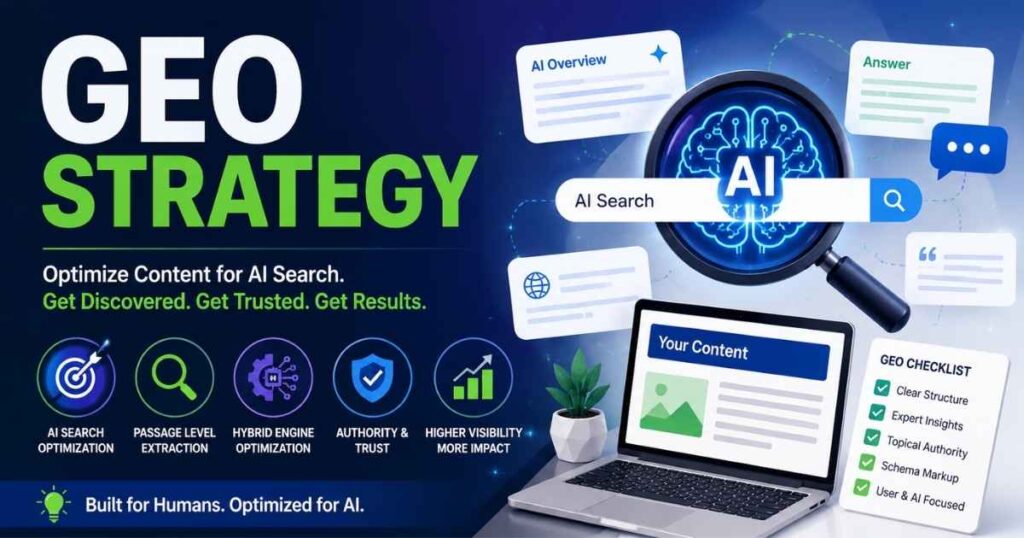
Search is changing fast. If you want your content to stay visible in AI-powered results, you need more than traditional SEO — you need a GEO strategy that helps machines understand, trust, and reuse your content.
AI search systems do not just rank pages; they synthesize answers from content they can confidently extract and cite. That means the best content is now built for both humans and AI, which is why topics like passage-level extraction, clear structure, and hybrid engine optimization matter so much.
What GEO means
GEO stands for Generative Engine Optimization. In simple terms, it is the practice of shaping your content so generative AI systems can find it, understand it, and use it in answers.
The idea is not to replace SEO. Instead, GEO builds on it by making your pages easier for AI tools to interpret, quote, and recommend while still following core search best practices.
Why AI search changes content strategy
Traditional search often rewards a page that matches a query well and earns clicks. AI search can answer the query directly, which means visibility may happen without a click at all.
That is why creators keep asking what matters more in AI search: ranking signals, content structure, authority, or clarity. The answer is that all of them matter, but clarity and retrievability are becoming much more important because AI systems need content they can confidently extract in small, accurate pieces.
This shift creates a new challenge and a new opportunity. If your content is built for extraction, it can show up in summaries, overviews, and chatbot answers even when the user never visits a standard results page.
Build for extraction
The strongest GEO tactic is simple: write content that is easy to break into useful passages. Search and AI systems increasingly work at the passage level, so a well-written section can perform better than a long page full of dense paragraphs.
To optimize for passage level extraction, use these rules:
- Put the main answer near the top.
- Use one idea per paragraph.
- Keep headings specific and descriptive.
- Add lists, tables, and short summaries where helpful.
- Use plain language instead of jargon when possible.
A useful test is this: can a section stand alone and still make sense? If yes, it is easier for AI systems to extract and cite accurately.
Use a hybrid engine mindset
Hybrid engine optimization means designing content for both traditional search engines and AI discovery systems at the same time. This matters because Google, AI overviews, chat assistants, and answer engines often value different signals, but they still depend on strong page fundamentals.
A hybrid engine optimization approach usually includes:
- Technical SEO basics like indexability, crawlability, and page speed.
- Clear topical coverage that answers real user questions.
- Structured content that AI can parse quickly.
- Authority signals such as original insights, statistics, expert references, and topical depth.
This is where many brands go wrong. They focus on AI visibility without fixing the underlying content quality or technical foundation, but AI systems still rely heavily on those basics.
Write for zero-click search
If you want to win zero click search, you need to think beyond the click. Your goal is not only to attract traffic, but also to become the source AI systems trust when they construct an answer.
That means your content should answer common questions directly and completely. Start with the conclusion, then expand with context, examples, and detail. This inverted-pyramid style works especially well for AI search because it gives the system a clear answer fast.
A strong zero-click strategy often includes:
- FAQ-style sections.
- Clear definitions.
- Step-by-step instructions.
- Short summaries under each major heading.
- Practical examples tied to real search intent.
For example, if someone searches “how to optimize content for AI tools or Generative Engine Optimization,” a page that gives a direct definition, then lists practical steps, has a much better chance of being reused in an AI answer than a vague opinion piece.
Add authority and trust
AI systems prefer content that looks credible and well supported. That means your pages should include original expertise, specific claims, and evidence wherever possible.
You can strengthen trust by:
- Citing data or studies.
- Including firsthand examples or experience.
- Writing clearly about who the content is for.
- Covering the topic from multiple angles.
- Updating content regularly so it stays current.
This is especially important for informational content because AI tools are more likely to surface content that appears reliable, complete, and easy to verify.
Use structure to guide AI
Headings are not just for readers; they are also signals for machines. Clear H2 and H3 headings help AI systems understand your page hierarchy and locate the most relevant passages faster.
To improve structure, use:
- H2s for major ideas.
- H3s for subtopics or steps.
- Short paragraphs with one main point each.
- Lists and tables when comparisons or processes matter.
- Schema markup where appropriate, especially FAQ and How-To formats.
The more predictable your structure, the easier it is for AI tools to extract accurate answers without misreading your intent.
Practical GEO checklist
Before publishing, run your content through this GEO checklist:
- Does the page answer the main query in the first few lines?
- Are the headings specific and question-based where useful?
- Can each section stand on its own as a useful passage?
- Does the page include original insights, examples, or proof?
- Is the content supported by technical SEO fundamentals?
- Are you writing for both users and AI systems, not just one or the other?
If you can answer yes to most of these, your content is much more likely to perform well in both classic search and AI-driven discovery.
Measure GEO performance
A strong GEO strategy should be measured just like any other content effort. Track whether your pages are appearing in AI summaries, answer engines, and zero-click search features, not just standard organic rankings.
You can also monitor indirect signals such as branded searches, engagement time, scroll depth, and whether certain sections of your content are being reused in AI-generated answers. Over time, these patterns show which topics, formats, and headings are most effective for AI visibility.
It helps to review content regularly and update sections that are outdated, too vague, or too long. The pages that perform best in AI search are usually the ones that stay clear, current, and easy to extract.
Common GEO mistakes
Many brands make the mistake of writing for algorithms instead of people. That usually leads to content that sounds technical but fails to answer the reader’s actual question clearly.
Another common issue is making pages too broad. If a post tries to cover everything, it becomes harder for AI systems to extract a clean, useful passage.
You should also avoid burying the main answer too far down the page. In AI search, the first few paragraphs matter a lot because they often determine whether your content gets reused in a response.
Finally, do not ignore content freshness. AI systems tend to favor pages that reflect current terminology, updated examples, and recent best practices.
Conclusion
The GEO strategy is not about gaming AI search. It is about making valuable content easier to understand, trust, and reuse across search engines and generative systems.
If you want to optimize content for AI search results, focus on clear answers, strong structure, topical authority, and hybrid engine optimization. That combination gives your content the best chance to win zero click search and remain visible as AI search continues to evolve.